
Introduction
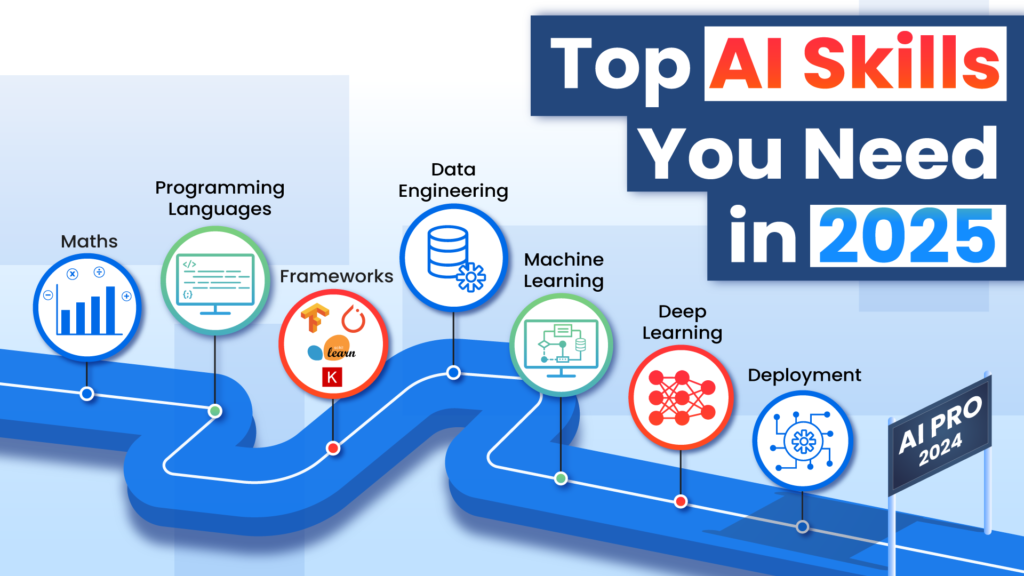
Top AI skills are not nice-to-haves in 2025—they’re must-haves. As artificial intelligence reshapes industries from healthcare to marketing, being proficient in these skills makes you future-proof, creative, and employable. Whether you want to develop intelligent systems, analyze data, or collaborate with intelligent automation, possessing top AI skills makes you job-relevant in an increasingly algorithm- and automation-driven job market.
AI is transforming the global economy and the world of work. It will add as much as $13 trillion to the world economy by 2030, states McKinsey. As of 2025, businesses need not only individuals familiar with the fundamentals of AI but also those who know how to apply and innovate using them. Demand for candidates with leading AI skills is exceeding supply, offering tantalizing possibilities for those willing to learn.
This blog discusses the most important AI skills you must learn in 2025, divided into two sections—AI skills to learn immediately and AI skills that will future-proof your career. If you are a student, a professional, or a career changer, these are the skills that will make you invaluable in the world of AI.
AI Skills to Learn in 2025
Top AI abilities are necessary in 2025 with more sectors relying on intelligent technologies. Abilities such as machine learning, natural language processing, deep learning, and computer vision are popular. These technologies drive chatbots, product suggestions, and autonomous systems we interact with daily. Python skills, data working, and how AI models work are now minimum job requirements. With AI becoming an integral aspect of business, gaining expertise in these leading AI skills places you ahead. Whether you’re just starting out or enhancing your skills, studying AI gives access to high-paying jobs in technology, healthcare, finance, and beyond. Begin today.
1. Machine Learning (ML)
Number one on the list of best AI skills, machine learning is the central power propelling the majority of smart systems in existence today. Machine learning enables machines to learn from experience and predict or make decisions without being programmed explicitly.
By 2025, machine learning powers applications in every significant industry. From Netflix’s recommendation algorithms and bank fraud detection to predictive factory maintenance and personalized medicine in the healthcare sector—ML is driving it all.
Learning to master ML involves knowing how to gather data, preprocess it, construct models, train them, and optimize performance. It is no longer sufficient just to know what ML is—you must construct it, modify it, and scale it.
Key Tools to Master:
- Scikit-learn
- TensorFlow
- PyTorch
2. Natural Language Processing (NLP)
Natural language processing enables machines to read and communicate with human language. This comprises speech recognition, translation, text generation, and sentiment analysis.
In 2025, tools such as ChatGPT, Siri, Alexa, and real-time translators heavily rely on NLP. Mastering NLP is among the most sought-after AI skills you must possess to remain competitive, particularly if you’re in the business of communication tools, customer support automation, or digital assistants.
Development of NLP-driven applications needs knowledge of tokenization, named entity recognition, and language models. The aim is to make machines speak and understand human languages—text and voice.
Must-Learn Libraries:
- NLTK
- SpaCy
- Hugging Face Transformers
3. Deep Learning
Deep learning, a subset of ML, leverages artificial neural networks to mimic human decision-making and pattern recognition. It makes advances in fields such as self-driving vehicles, medical imaging, voice generation, and video classification.
In 2025, deep learning professionals are driving the future. Being able to implement and train convolutional neural networks (CNNs) to perform image tasks or recurrent neural networks (RNNs) for sequential data sets you apart.
Being able to master deep learning involves handling large datasets and creating complex model architectures—a top AI skill must-have.
Platforms to Explore:
- Keras
- PyTorch
- TensorFlow
4. AI Programming Languages
No AI skill is complete without a robust background in programming. Python remains the favorite language in AI because it’s readable, versatile, and has a vast wealth of libraries.
Python is the must-have in 2025 for developing ML pipelines, data science analysis, deep learning models, and putting AI systems into production. Learning programming is not optional—it’s one of the most essential top AI skills in the present.
Though Python reigns supreme, R remains handy for data science, and Java finds usage in enterprise-level applications where speed is critical.
Languages to Master:
- Python
- R
- Java
5. Computer Vision
Computer vision is the technology used by machines to ‘see’—to understand and process visual information from the world. It’s a rapidly growing discipline with real-world use in many industries.
In 2025, computer vision is driving everything from face recognition software and self-driving cars to smart surveillance and defect detection on factory floors. As more industries adopt vision-based AI, it’s one of the best AI skills to learn.
Experts in computer vision can create real-time object detection, image classification, gesture detection, and more.
Essential Libraries:
- OpenCV
- YOLO (You Only Look Once)
- TensorFlow Object Detection API
6. AI Ethics and Responsible AI
As AI grows stronger and embedded in mission-critical systems, ethics are more relevant than ever. One of the leading AI competencies for 2025 is designing and understanding AI that is transparent, accountable, and just.
With issues of data bias, algorithmic discrimination, and explainability being a concern, businesses are looking more and more to prioritize developing ethical AI. Experts need to know how to reduce bias, protect data privacy, and provide explanations for model choices.
Apart from technical expertise, you’ll require a sound understanding of social, legal, and philosophical paradigms that inform ethical AI.
Areas to Learn:
- Bias Mitigation
- Model Explainability
- Data Privacy
- Fairness in AI
AI Skills for the Future
In 2025, being at the forefront of the best AI skills is not merely following the trends—it’s about setting yourself up for long-term success. As AI gets intelligent and integrated into day-to-day systems, the experts who learn to merge with sophisticated, useful skills will spearhead the future. Below are five AI skills for the future that will design your career trajectory.
1. Edge AI Development
Edge AI is the future of real-time decision-making. Cloud-based systems are unlike edge AI, which processes data where it’s gathered—on devices such as smart cameras, wearables, drones, or vehicles. This cuts down on delay and makes the system faster and more responsive.
Why it matters in 2025
With the growth of IoT and smart devices, premium AI skills such as edge computing are in huge demand these days, particularly in industries such as healthcare, manufacturing, and defense.
Tools to Learn:
- OpenVINO
- TensorFlow Lite
- NVIDIA Jetson
These tools enable you to create efficient, lightweight AI systems that operate offline.
2. AutoML (Automated Machine Learning)
AutoML simplifies machine learning model creation through automation of primary steps such as data cleaning, model choosing, and tuning. You don’t require extensive coding expertise to effectively utilize it.
Why it’s important in 2025:
AutoML enables teams to work quicker and decrease mistakes. Understanding how to use or tailor AutoML tools ranks as one of the most popular AI abilities required by companies.
Popular Platforms:
- Google AutoML
- H2O.ai
- DataRobot
These platforms make it easier for novices and experts to develop robust models with fewer efforts.
3. Reinforcement Learning
Reinforcement learning trains AI using rewards and penalties. Rather than being trained on static data, the AI engages with its environment and learns along the way.
Why it matters in 2025:
This is what enables robots, automation, self-driving cars, and smart factories. It is at the root of machine building capabilities to adapt and learn.
Tools to Explore:
- OpenAI Gym
- Unity ML-Agents
- Stable Baselines3
These tools assist you in simulating environments for training AI.
4. Data Visualization with AI
Data visualization refers to making complex data simple. With AI, visualizations now feature intelligent predictions, automatic abstracts, and notifications that make insights more understandable.
Why it matters in 2025:
Good explanations of data matter in all sectors—from marketing to healthcare. It is one of the most useful top AI skills as it aids teams in making improved decisions.
Key Skills to Master:
- Predictive analytics
- Data storytelling
- Dashboard design
Top Tools: Tableau, Power BI, Google Looker
5. Prompt Engineering for AI Tools
Prompt engineering is the science of creating good questions. As AI tools like ChatGPT, Claude, and Gemini become ubiquitous at work, understanding how to provide effective prompts is becoming one of the most important AI skills.
Why it matters in 2025:
The better your prompt, the better the AI output—whether it’s writing, coding, or analyzing.
Tips to Master:
- Use zero-shot and few-shot prompting
- Apply system-level instructions
- Practice with tone, context, and structure
Developing these leading-edge AI skills sets you up not only for 2025 but for a future of technology. From edge AI to smart images and prompt engineering, these skills set you ahead in competitive markets such as healthcare, finance, automation, and more. Get ahead—learn today what the world will require tomorrow.
Final Thoughts
Top AI skills are the building blocks of an career-proof future. In 2025 and beyond, they’re not just nice to have—they’re necessary. From the core technical competencies of machine learning and deep learning to high-growth fields such as AutoML and prompt engineering, AI knowledge is changing rapidly.
But don’t be intimidated by the sophistication. Begin slowly. Take an online course in Python. Experiment with creating a simple machine learning model. Test free software such as ChatGPT or Google’s Teachable Machine to observe how AI systems react to inputs. These acts establish confidence and hands-on expertise.
Whether you’re a developer, marketer, business owner, or student, learning leading AI skills maintains your competitiveness. The world is rapidly evolving, and the people who know and implement AI will be in a stronger position to lead. So remain curious. Continuously learn. And begin constructing your AI journey today.