
Introduction
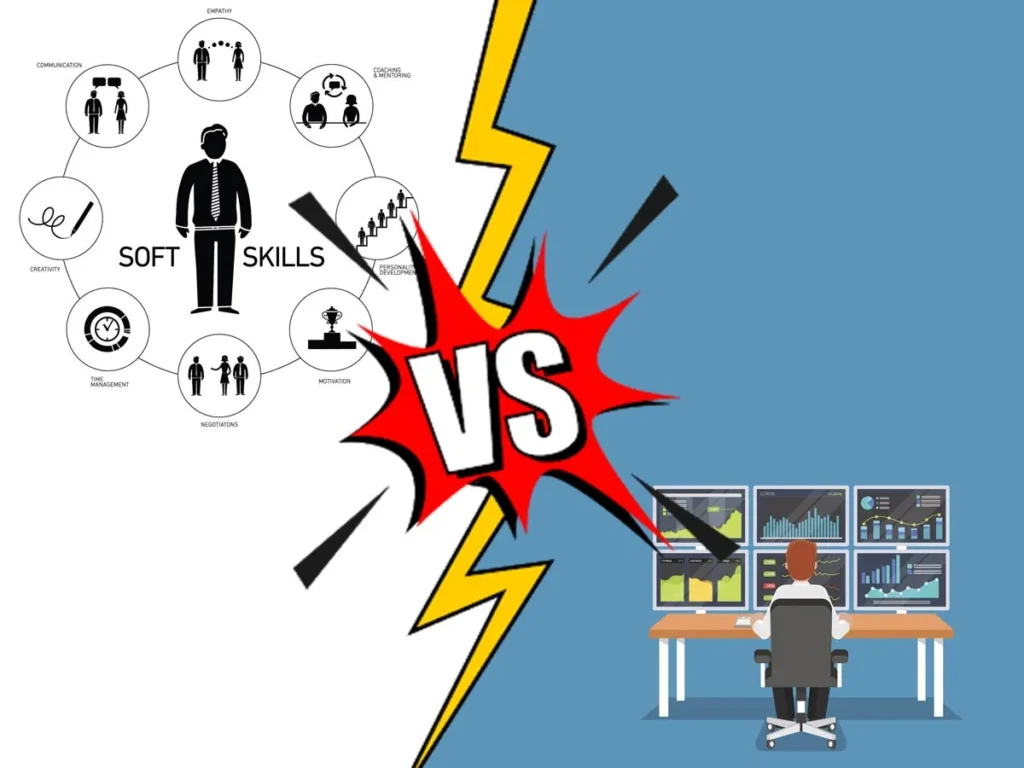
Technical Skills vs Soft Skills is among the most significant discussions of our current career landscape. As we progress in 2025, careers are evolving rapidly—and so are employers’ expectations. It’s not sufficient anymore to merely possess robust technical or technological knowledge. You also require the capacity to communicate, integrate new challenges, and work well with others.
Technically speaking, technical skills are your hard skills. Those are items you can acquire through classes, training, or on-the-job experience—such as coding, data analysis, cloud computing, and cybersecurity. They enable you to carry out your specific job functions.
Soft skills, on the other hand, are your people skills and your personality. They are things like communication, working in teams, being creative, leadership, time management, and emotional intelligence. Soft skills enable you to work well in a team, solve problems, and manage projects.
In 2025, employers are not picking between technical skills and soft skills—both are desired. Businesses today seek professionals with the ability to resolve complicated problems and communicate effectively. Individuals who can analyze information and handle pressure. The ideal candidates are those with a blend of both.
Here in this blog, we’re going to tell you many of the most important skills for 2025, dissect why technical and soft skills are so important, and assist you in determining how to future-proof your career in an increasingly competitive job market.
Most Valuable Skills in 2025
Technical skills versus soft skills is no longer a question—it’s the guideline building the 2025 workforce. As we enter an age of automation, AI, and non-stop evolution, employers aren’t selecting between technical prowess and emotional intelligence—they’re expecting both.
In this new world, it’s not simply sufficient to be a great coder or a great communicator in isolation. It’s the greatest professionals who integrate technical expertise with human understanding—who can interpret data and share the narrative behind it, who can learn the tools and guide organizations through transformation. It’s the blend that describes what makes someone future-ready. Let’s find out the 10 most valuable skills for 2025—a combination of hard and soft skills that are defining today’s professional world.
1. AI Literacy
AI literacy is at the top of the list of useful skills for a reason. Artificial intelligence is no longer science fiction—it’s the foundation of today’s business operations.
Why it’s worth it: By 2025, experts will no longer have to create machine learning models, but they should know how AI tools work, what they can and can’t do, and how they can fail. Whether it is ChatGPT for writing or Midjourney for graphics, the ability to prompt, assess, and use AI ethically provides you with a competitive advantage.
A marketing manager who is AI literate, for example, can test campaigns automatically, create reports in mere seconds, and provide higher-quality insights. But it also involves understanding when not to take AI at face value—such as preventing biased outcomes in recruitment or financial risk algorithms. In the overall debate of technical skills versus soft skills, AI literacy encompasses both. It demands digital proficiency as well as ethical decision-making.
2. Data Interpretation & Critical Thinking
We’re swimming in data, yet drowning in confusion. Simply accessing dashboards doesn’t equate to actionable insight.
Why it’s valuable: Tools like Google Analytics 4, Power BI, and Looker have made data more accessible, but interpretation is still a human art. Professionals who ask “why” behind every trend—and back it up with context—are indispensable.
For instance, an unexpected traffic dip may appear scary. But a sound critical thinker will verify whether the culprit is a Google algo change, broken link architecture, or UX adjustment. Data interpretation is where the technical skills meet soft skills again. You’ll require the technical tools to discover patterns and critical thinking to determine what it implies.
3. Mental Flexibility & Learning Agility
Today’s bleeding-edge technology may be obsolete by next year. That’s why flexibility is not an advantage—rather, it’s a survival tactic.
Why it’s worth it: Learning agility requires mastering new skills, tech, or workflows in a hurry. Perhaps it’s moving from Excel to Python, or becoming proficient in a new UX tool like Figma after doing Photoshop for years. People who learn to love change, even when it’s painful, remain employable longer.
Mental flexibility is the ultimate answer to the conflict of technical skills vs soft skills—a mindset that opens both doors with equal eagerness.
4. Hybrid Technical Skill Sets
The contemporary workplace prefers T-shaped professionals—deeply specialized in one area and workingly knowledgeable across others.
Why it’s valuable: Imagine a digital marketer who knows basic HTML, or a project manager who can query a SQL database. These hybrid pros don’t just execute—they communicate better, estimate timelines realistically, and anticipate cross-functional roadblocks.
This hybrid skill set makes collaboration smoother and execution faster. It’s not about knowing everything—it’s about connecting the dots. And in the constant debate of technical skills versus soft skills, these hybrid positions prove that both together create synergy, not tension.
5. Business Communication
Fantastic ideas perish without effective communication. Whether pitching, presenting, or solving problems—how you communicate matters a great deal.
Why it matters: Business communication is more than simply correct grammar. It’s about clarity, brevity, tone, and delivery. Can you clearly explain a technical idea to a non-technical customer? Can you write an effective report that inspires action?
particularly in remote or hybrid work teams, written clarity matters. Miscommunication frequently results in delays, mistakes, or even lost customers. Experts who excel at business communication enhance the worth of their technical competencies with soft skills such as storytelling and convincing.
6. Systems Thinking & Process Optimization
Modern issues are not usually standalone. They’re symptoms of faulty systems—and fixing them requires more than technical fixes.
Why it’s worth it: System thinkers see the larger picture. Rather than repairing only one broken widget, they overhaul the whole machine. With workflow mapping, automation scripts, or CRMs as their tools, they optimize operations without losing the human touch.
For instance, improving a customer service process might call for technical automation and empathy to prevent dehumanizing interactions. This is another pivotal point where technical skills vs soft skills need to balance one another. A solution that’s purely technical has no human touch; a purely emotional response mayn’t scale. Systems thinkers create balance.
7. Ethical Judgment & Tech Responsibility
With a data-driven, AI-powered world, ethics is no longer an afterthought—it’s a requirement.
Why it’s important: From facial recognition to algorithmic hiring, current technology is powerful—but perilous. Experts need to ask: Is this equitable? Is the data prejudiced? Who might this hurt?
These aren’t coding questions—these are questions of values. Ethical decision-making requires transparency, responsibility, and courage to raise a voice when something doesn’t feel right. So in judging technical skills against soft skills, ethics is the binding agent that keeps innovation from running ahead of morality. By 2025, the most dependable experts won’t be the most intelligent—they’ll be the most ethical.
8. Making Decisions in Uncertainty
The majority of actual business situations don’t present ideal data. And still, decisions need to be made.
Why it’s worth it: The ability to make the right-enough choice, even amidst uncertainty, is essential. It’s not perfect—it’s progress. Whether launching a campaign, bringing in a team member, or expanding into a new market, those who proceed despite unknowns are priceless.
This skill integrates analytical thinking (tech) with emotional intelligence (soft)—you weigh probabilities, frame scenarios, and stay emotionally calm under fire. Decision-making in the face of ambiguity is one of the best illustrations of technical skills vs soft skills functioning harmoniously.
9. Cross-Cultural & Interdisciplinary Teamwork
Work is no longer geographically or departmentally bound. Teamwork cuts across countries, cultures, and disciplines.
Why it’s worth it: Today’s teams are composed of marketers in India, developers in Germany, and clients in the U.S. The ability to communicate across time zones, culture, and functional backgrounds is a hallmark skill.
Aid like Zoom and Slack facilitates collaboration—but hard work still relies on soft skills such as empathy, flexibility, and tolerance for diversity. Technical literacy, on the other hand, makes you aware of the limitations and possibilities of your collaborators. This is one area where technical skills vs soft skills don’t clash—they complement each other to foster trust, innovation, and common purpose.
10. Digital Security Awareness
As cyberattacks increase, every employee becomes a line of defense—not only IT.
Why it’s worth it: With remote work as the new normal, professionals are handling sensitive information outside of customary office safeguards. Learning basic security practices—such as recognizing phishing attacks, implementing MFA, and practicing digital hygiene—is essential.
But digital security also needs discipline, integrity, and vigilance—softer qualities that translate to ongoing protection. The right attitude can dodge multimillion-dollar breaches. Cybersecurity is the only exception where technical skills vs soft skills converge into one essential competency—action supported by awareness.
The actual takeaway in 2025 isn’t to take a side in the technical skills vs soft skills debate—but to become expert practitioners of synthesis. Employers desire employees who can code and converse, analyze and relate, improve systems and get people.
The future is for hybrid thinkers—individuals who understand how to work in digital spaces and remain human-first in their mindset. No matter if you’re a future pro, team lead, or entrepreneur, the time is now to invest both in your equipment and in your personality. Because in the era of AI, it’s the balanced professionals—those with hard skills in their head and soft skills in their heart—who are going to pave the way.
Top Soft Skills 2025
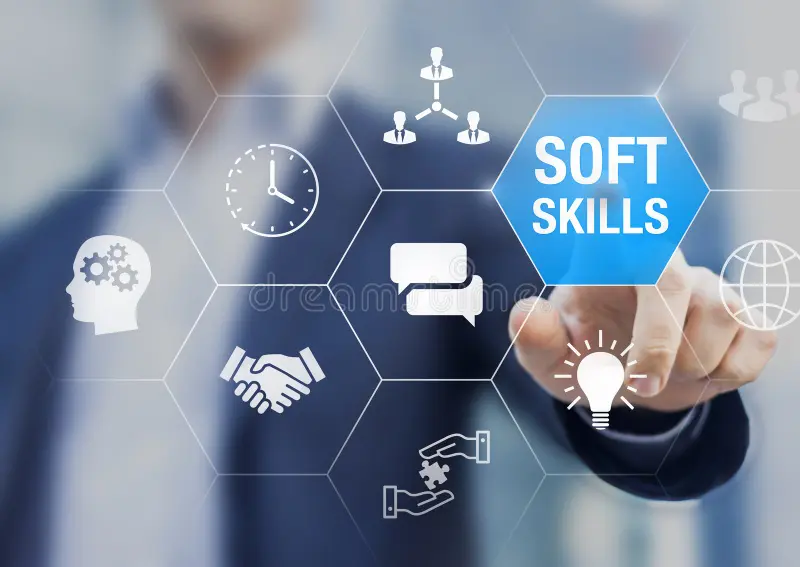
Technical skills versus soft skills is no longer a one-way conversation—it’s a reality that professionals need to work around in 2025. While technical expertise opens doors, it’s soft skills that lead to long-term success. In the ever-growing digital landscape, these human-related abilities are what distinguish top professionals from the rest.
These are the top 5 soft skills that will be most useful in 2025 to help you stand out, grow, and lead in any industry:
Technical skills versus soft skills is no longer a one-way conversation—it’s a reality that professionals need to work around in 2025. While technical expertise opens doors, it’s soft skills that lead to long-term success. In the ever-growing digital landscape, these human-related abilities are what distinguish top professionals from the rest.
These are the top 5 soft skills that will be most useful in 2025 to help you stand out, grow, and lead in any industry:
1. Emotional Intelligence (EQ)
Emotional intelligence is recognizing, understanding, and being able to manage your own feelings and being sensitive to others’ feelings. It is heavily involved in leadership, empathy, and conflict resolution.
In the workplace, EQ will help you better communicate, handle stressful situations, and resolve disagreements without escalating them. By 2025, companies will value EQ because it directly impacts team dynamics, customer relationships, and even innovation.
With technology and automation dominating technical work, emotional intelligence is the human advantage. It thus becomes a key component in technical skills vs soft skills equilibrium—enabling individuals to lead with compassion in an ever-evolving world.
2. Adaptability
Adaptability is the ability to shift rapidly to new tools, workflows, challenges, and environments. In the modern workplace, change is the only constant—new technologies, changing priorities, and transforming business models are the order of the day.
In 2025, employers will value those who not only manage change but also prosper in it. Being flexible makes you remain relevant and effective even when the playbook is altered. It’s a soft skill that complements your technical skillset—because what’s the point of knowing a system if you can’t shift when it shifts?
In the debate around technical skills versus soft skills, flexibility is the bridge. It enables individuals to continuously learn, refresh their skills, and stay tough during turbulent times.
3. Critical Thinking
Critical thinking refers to the capacity to evaluate information objectively, spot patterns, and make informed decisions. It’s the springboard of problem-solving, decision-making, and strategic planning.
By 2025, with so much information at our fingertips, critical thinking will be an essential skill to sort through information and pick the right way forward.
Despite AI creating reports and trends, it requires human judgment to know what the data implies and what to do with it. That’s why technical skills vs soft skills meet in critical thinking—bridging technical understanding with human decision.
4. Communication
Communication is not just talking—it’s listening, writing, and communicating ideas well.In today’s workplaces, teamwork occurs departmentally, platformically, and culturally. By 2025, remote labor and digital communication technologies make effective messaging more critical than ever before.
Regardless of the sophistication of your technical competencies, you require communication to convey complicated concepts, manage teams, and establish trust. That makes communication a timeless soft skill that enables every other capability.
5. Collaboration
Collaboration is the capacity to collaborate effectively with others—be it a team, departments, or geographically distributed teams.
The promotion of most significant projects in today’s world is team-based. Success is based on how effectively individuals collaborate with each other. In 2025, cross-functional collaboration will be the norm in all industries—from tech and healthcare to education and finance.
Soft skills such as respectfulness, patience, and mutual responsibility are necessary for effective collaboration. Teamwork is the essence of how technical skills vs soft skills operate in practice environments—since technical success is seldom accomplished single-handedly.
Top Technical Skills
In 2025’s digital-first era, technical skills are changing rapidly. Business organizations across sectors are eagerly seeking the expertise of professionals who are equipped to work with new technologies, automate tasks, and make intelligent decisions out of data. Below are the top 5 technical skills in 2025 that job seekers as well as working professionals must master:
1. Artificial Intelligence (AI) and Machine Learning (ML)
AI and ML are no longer the domain of tech firms—they’re ubiquitous. From chatbots in customer service to AI-based healthcare predictive systems, AI is changing the way we live and work. Employers already expect potential employees to know how such systems work and where they can be used in business.
If you can train machine learning models, code with algorithms, or even use AI tools such as ChatGPT or Midjourney tactically, you’re on the right track.
Why it matters: Artificial intelligence is the driving force of automation and intelligent decision-making. Employers seek workers who know how to effectively utilize AI tools—or at least possess some awareness about how AI impacts their field.
2. Data Analysis and Data Literacy
Data is at the center of every business now. Being able to gather, clean, analyze, and interpret data is among the most useful technical skills in 2025. It’s not only for data scientists—marketers, HR professionals, and even sales teams require basic data skills.
Applications like Excel, SQL, Python, Power BI, and Tableau are widely used for converting raw numbers into insights that aid businesses in growth.
Why it matters: Companies depend on information to make intelligent choices. If you’re able to identify trends in data and turn them into action, you’re a valuable asset.
3. Cloud Computing
The cloud migration is gaining pace. Companies don’t keep files and execute programs on local machines anymore—they utilize cloud platforms such as Amazon Web Services (AWS), Google Cloud Platform (GCP), and Microsoft Azure.
Having knowledge of how to deploy, manage, or even secure cloud infrastructure is a significant plus. Whether working in IT, development, or DevOps, having cloud knowledge is the norm.
Why it matters: Cloud computing provides scalability, flexibility, and cost-effectiveness. Companies require experts who can assist them to go faster and securely in the cloud.
4. Cybersecurity
With cyberattacks and data breaches on the upswing, cybersecurity is more crucial than ever. It’s not merely a matter of securing networks—it’s securing business continuity, customer trust, and sensitive information.
Knowledge of firewalls, network security, encryption, and risk assessments—even if you’re not in a specialized security function—can make you stand out.
Why it matters: All businesses require cybersecurity skills. Even elementary awareness of cyber threats is now a technical competency requirement.
5. Programming and Software Development
Coding is still one of the most basic and sharable technical skills in 2025. From developing smartphone apps to business process automation, programming addresses real-world issues.
Programming languages such as Python, JavaScript, and Java still rule. Even if you are not a professional developer, knowing how software is coded can assist you in working more effectively with tech teams.
Why it matters: Practically every sector—ranging from fashion to finance—employs software. If you can write, read, or comprehend code, you’ll have more career opportunities.
Final Thoughts: Thriving in 2025 Requires Balance, Not Bias
In the current debate regarding technical skills versus soft skills, the solution isn’t either/or—it’s learning to balance. As we enter 2025, the most effective professionals will be those with a healthy blend of deep technical knowledge and solid interpersonal skills.
Technical skills enable you to execute specialized tasks, adjust to new equipment, and remain up-to-date in a rapidly evolving digital age. However, soft skills such as communication, emotional intelligence, and flexibility enable you to lead groups, fix issues, and work together efficiently. Both sets of skills make you future-proof.
Whatever you’re entering the workforce for, career-changing for, or leadership-bound for, prioritize the development of both. Master the new hard skills in your industry—and don’t neglect the human side of business. Because in 2025 and into the future, employers are not only looking for talent—they’re looking for well-balanced professionals who bring head and heart to the equation.